




Case study

Bringing Meta ads in-house

The agency brought in leads. We needed buyers.

Project overview

Metana had spent over $60K on an agency with little to show for it. I helped build its in-house Meta ads from scratch and grew into owning the creative strategy. We closed the company's first upfront high-ticket sale from performance ads with the cybersecurity bootcamp. Then we hit a wall trying to repeat that win for the Solidity bootcamp, and recovered by cutting the experiments and going back to cybersecurity alone. Between July and September 2026, account spend fell 57% while leads doubled and cost per lead fell 79%.

Where
Metana
When
Jan – Oct 2026
My title
Creative Strategist

Approach

  1. 01

    Judge every ad and campaign by booked calls and sales, not by how Meta's algorithm rates it.

  2. 02

    Split the account by region and funnel, so each could be measured and cut on its own.

  3. 03

    Stop what doesn't work, and put the budget behind what does.

01 · Where it started

Background

Metana sells Web3 and tech bootcamps priced at $9K–$12K. Before I joined, an agency ran its paid acquisition for over $60,000 with little to no return. That period did leave something useful: the agency built the high-ticket closer funnel and the lead flow. But almost none of the leads converted, and the few that did only bought on loan options. I'd run Meta ads for employer branding at AuroraRCM, and I joined Metana to build its social channels organically. Then the company decided to bring paid media in-house, because paid ads were one of its competitors' biggest acquisition channels, and I moved into the new team.

02 · What was in the way

The challenge

At $9K–$12K nobody buys on impulse, and the agency had shown that leads alone don't produce sales. The new team had to find creative that made people book a call and pay, and a campaign structure that put budget where buyers actually were.

03 · What was mine

My role

Creative Strategist, Metana

At first I coordinated with the creative team and got assets ready for launch. As the work progressed I took on the creative strategy and contributed to the targeting criteria. The paid media specialist owned the budget and ran the account.

04 · What I did, step by step

The process

Phase 1: Launch (January–February 2026)

  1. 1

    Launched the cybersecurity bootcamp campaign on 26 January, with separate ad groups for Europe, the USA and Canada, so each region's budget could be controlled and compared.

  2. 2

    Ran two landing-page funnels side by side: the bootcamp page and a quiz. The quiz brought 12 leads but only 4 booked calls, so we paused it in February and moved all traffic to the bootcamp page.

  3. 3

    Narrowed Europe from 14 countries to 7, first using Metana's past admissions and booked-call data, then live lead volume, booking rate and lead quality.

  4. 4

    Tested statics, carousels, UGC and other video formats. The statics did well by Meta's own measures but didn't convert. Video did: the cybersecurity launch video brought in the first upfront high-ticket sale in Metana's history of running performance ads.

Phase 2: Scaling and experiments (March–July 2026)

  1. 5

    From March, tried to scale the Solidity bootcamp by repeating the format that had worked for cybersecurity, with more budget behind it. Meta took a long time to learn, and cost per lead climbed from $16–$20 in February and March to $54 across the account by July.

  2. 6

    Focused on the USA from April, after it produced better-quality leads than Europe and Canada.

  3. 7

    Ran a series of experiments alongside: campaigns for other bootcamps, new markets and retargeting.

  4. 8

    Judged each experiment on booked calls and show-ups, not lead volume, and paused the ones that didn't deliver.

Phase 3: Focus (July–October 2026)

  1. 9

    Cut the remaining underperforming experiments and put all paid spend behind the cybersecurity bootcamp, the programme that had already proven itself.

  2. 10

    Narrowed US targeting to six selected cities and weighted bidding towards Instagram.

  3. 11

    Tracked cost per lead, cost per booking and cost per scheduled meeting every month.

Spotlight

The cybersecurity launch video

The launch creative for Metana’s cybersecurity bootcamp: a short, square motion graphic built around a handful of plain claims about the programme.

Format
Square, 1:1
Length
24 seconds
Programme
Cybersecurity bootcamp

Press play. It has sound.

05 · What changed

Outcomes

Measure (whole Meta account)July 2026September 2026Change
Spend$5,143$2,220−57%
Leads95200+111%
Cost per lead$54.13$11.10−79%
Booked calls4769+47%
Cost per booking$109.42$32.17−71%
Whole Meta account in both months. Most of the spend drop came from cutting experiments that weren't producing booked calls; by September, all spend was on cybersecurity call-booking campaigns.
  • The first upfront high-ticket sale from Metana's performance ads ($7,500, March 2026), and a second $7,500 US sale in September 2026.
  • In the first six weeks (to 5 March 2026), 166 leads from Meta, 88 booked calls and 146 marketing-qualified leads.
  • In the US cybersecurity campaign, cost per scheduled meeting fell three periods running: $41.09 in August, $33.13 in September and $28.98 for 1–23 October.
  • October 1–23 held the new level: $11.71 per lead and $31.91 per booking.
  • Compared with the agency period, paid spend fell from about $60K to about $33K while cash collected rose 30x.

This was a team result: I owned creative strategy, and the paid media specialist owned the budget and ran the account.

The agency comparison is as reported by the CEO. The $33K also covered marketing for Minutely, an AI learning app.

Meeting counts use Meta's default attribution, not unique CRM bookings.

  • −57%Spend
  • +111%Leads
  • −79%Cost per lead
  • +47%Booked calls
  • −71%Cost per booking

06 · Learnings

What I took from it

An ad Meta's algorithm likes isn't the same as an ad that sells: judge creative by booked calls and payments. A format that wins for one bootcamp won't automatically win for another; scaling the Solidity bootcamp on the cybersecurity playbook pushed cost per lead up while Meta was still learning. And experiments only pay off if you stop the ones that don't work: focusing on one bootcamp beat spreading budget across many.
Elisha Claessen

07 · Tools I used

The toolkit

The platforms I used on this project.

  • Figma
  • Instagram
  • Facebook
  • Meta Ads Manager
  • Canva
  • DaVinci ResolveVideo editing
  • NotionScripts
  • Google Drive
  • HubSpot CRM
  • Google Analytics
  • Slack
  • Google Meet
  • Claude
  • ChatGPT
  • Fiverr
  • Backstage
  • ElevenLabs
  • ManyChat

More from Metana

  • MetanaDec 2025 – present

    Instagram views in 90 days
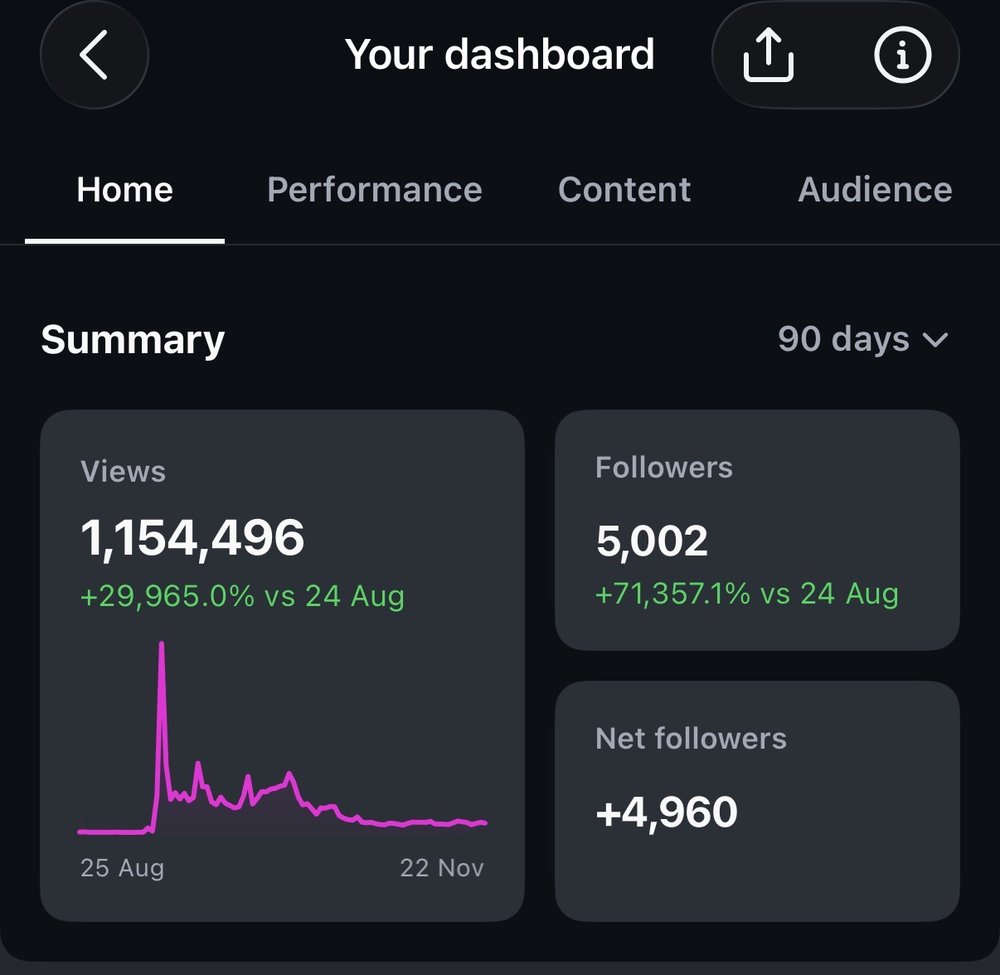
    Instagram dashboard summary for 90 days: 1,154,496 views, 5,002 followers and 4,960 net new followers, with a line chart of daily views from 25 August to 22 November.

    Selling an AI app to people over 40.

    Fiverr comparison uses the rates we were quoted at the time: $30–$50 for a 30–50 second video.

    Instagram figures are from the 90-day account dashboard (25 August – 22 November 2026). Never describe them as monthly views. Update the figures and dates when they're refreshed.

  • MetanaDec 2025 – present

    open rate on one email campaign

    A 50% open rate and two closed deals from one campaign.

    This was a joint piece of work with Metana's sales manager.

Want the bigger picture at Metana?